
Tired of Chasing Clients? Here is How to Automate Your Follow-Up Emails in Melbourne
Discover how Melbourne small businesses use OmniSAM to automate follow-up emails, convert leads and stop losing clients.
Table of Contents
- •Why Your Follow-Up Is Broken and It Is Not Your Fault
- •What Automated Email Follow-Up Actually Means
- •The Follow-Up Emails Every Melbourne Small Business Needs
- •The Immediate Enquiry Response
- •The 24-Hour Follow-Up
- •The Three to Five Day Value Email
- •The Last Touch Email
- •The Post-Appointment Follow-Up
- •The No-Show Recovery Email
- •How to Set Up Automated Follow-Up Emails Without Feeling Overwhelmed
- •What Melbourne Businesses Are Seeing When They Get This Right
- •Why Melbourne Businesses Trust OmniSAM to Handle Their Follow-Up
- •Common Mistakes Melbourne Business Owners Make With Email Automation
- •Making the emails sound robotic
- •Sending too many emails too close together
- •Forgetting to add conditions
- •Never reviewing the sequence after launch
- •Using a platform that is not Australian-compliant
- •Getting Started With Automated Follow-Up Today
There is a moment every Melbourne small business owner knows well. You send a quote. You have a great discovery call. Someone fills out your enquiry form and says they are really interested. And then nothing. Silence. You wait a few days, tell yourself you will follow up tomorrow, and tomorrow turns into next week. By that point it feels too awkward to reach out at all.
So the lead disappears. Not because they were not interested. Not because your service was not good enough. But because the follow-up never happened.
This is one of the most common and most costly problems in small business. And the frustrating part is that it is entirely fixable. Not by working harder or being more disciplined, but by setting up a system that follows up for you automatically, every single time, without you having to think about it.
That system is email automation. And for Melbourne small business owners in 2026, knowing how to automate follow-up emails is one of the highest-return investments you can make in your business this year.
This guide covers exactly why your follow-up is probably falling short right now, what automated email follow-up actually looks like in practice, how to get it set up without needing a tech background, and what results Melbourne businesses are seeing when they get this right.
Why Your Follow-Up Is Broken and It Is Not Your Fault
The follow-up problem is not a motivation problem or a discipline problem. It is a capacity problem.
Melbourne small business owners are running everything at once. You are doing the actual work, managing existing clients, handling new enquiries, keeping on top of invoices, staying active on social media, and trying to have some sort of life outside the business. In that context, manually following up every single lead with the right message at the right time is simply not realistic. Something always takes priority. The follow-up always gets pushed.
And the cost of that is real. According to the Australian Small Business and Family Enterprise Ombudsman, small businesses consistently lose potential revenue not through poor service but through inconsistent follow-up and communication. A lead that does not hear back within 24 hours is far less likely to convert than one that receives an immediate, helpful response.
The solution is not to work more. It is to set up automated email follow-up that runs quietly in the background while you get on with the actual work. Client follow-up automation across Australia has become one of the most practical and affordable investments a small business can make, and Melbourne businesses are leading the way.
What Automated Email Follow-Up Actually Means
Before we get into the how, let us get clear on what we are actually talking about.
Automated email follow-up is a sequence of pre-written emails sent to a contact automatically based on a trigger or a set of conditions. You write the emails once, set the timing and the rules, and the system handles everything from there. The right message goes to the right person at the right time without you touching it manually.
For a Melbourne small business, that might look like this. A new client enquires through your website at 9pm on a Tuesday. Your system sends a warm, personalised reply within seconds. If they do not respond within 24 hours, a follow-up goes out automatically. If they still have not booked after three days, another message goes out. If they do book a call, a confirmation lands in their inbox immediately, followed by a reminder the day before and another one an hour before the call. All of this happens without you sending a single email manually.
That is how to automate follow-up emails in a way that genuinely works for Melbourne small businesses. Not a mass email blast. A thoughtful, well-timed sequence that feels personal even though it runs automatically.
This is what client follow-up automation across Australia is moving towards, and Melbourne businesses that have already made the shift are seeing it in their conversion rates, client retention, and day-to-day peace of mind.
The Follow-Up Emails Every Melbourne Small Business Needs
Not all follow-up emails are created equal. The most effective automated sequences are built around the specific moments in your client journey where leads typically go quiet or fall away. Here are the most important ones for a Melbourne service business.
The Immediate Enquiry Response
This is the single most important automated email you can set up. When someone enquires about your services, they are at peak interest right at that moment. Every hour that passes without a response, their interest drops and the chance of them going elsewhere goes up.
An immediate automated response does not need to be long. It needs to arrive quickly, acknowledge their enquiry warmly, set expectations for what happens next, and give them a clear next step. Done well, this one email alone can significantly lift the percentage of enquiries that turn into paying clients.
The 24-Hour Follow-Up
If someone enquires and does not respond to your initial message within 24 hours, a gentle follow-up goes out automatically. This is not pushy. It is helpful. Most people who go quiet after an enquiry are simply busy. A warm, well-timed follow-up reminds them you exist and makes it easy to take the next step.
Melbourne small business owners who set up automated email follow-up at the 24-hour mark consistently see stronger response rates from leads they assumed had gone cold. The timing is close enough that the enquiry is still fresh in the lead's mind, but not so soon that it feels desperate.
The Three to Five Day Value Email
If a lead still has not responded after 24 hours, the next follow-up should offer something useful rather than just another nudge. Share something relevant to their situation. Tell a story about how you helped a similar business. Make the email about them, not about you trying to close the sale.
This is where email automation for Melbourne service businesses gets genuinely powerful. Instead of a bland "just checking in" message, you are sending something that demonstrates real expertise, builds trust, and reminds the lead exactly why they reached out in the first place.
The Last Touch Email
Every sequence needs a graceful exit. A final email that lets the lead know you are not going to keep nudging them, but that the door remains open. This email converts more fence-sitters than most business owners expect. There is something about a genuine, no-pressure final message that prompts people to make a decision they had been putting off.
The Post-Appointment Follow-Up
After every completed call, meeting, or session, an automated follow-up should go out within the hour. Thank them for their time. Reference the key things you covered. Make the next step clear and easy to take. This email is particularly powerful because it lands while the conversation is still fresh and the motivation to move forward is at its highest.
The No-Show Recovery Email
For Melbourne service businesses that rely on booked appointments, the no-show recovery email is essential. Service businesses lose more revenue to no-shows than almost any other communication breakdown. When someone does not show up, an automatic message goes out shortly after, checking in warmly and making it easy to rebook. Done without judgment and with genuine care, this email brings back a meaningful number of no-shows who would otherwise be lost for good.
How to Set Up Automated Follow-Up Emails Without Feeling Overwhelmed
Most Melbourne small business owners either get excited at this point or quietly switch off because they assume the setup is going to be complicated. It is not. Knowing how to automate follow-up emails does not require a developer or a technical background. Here is a simple approach that works for most service businesses.
Step 1 — Choose the right platform
You cannot set up email automation without the right platform. And not all platforms are built for Australian small businesses. You need something with a visual automation builder, genuine compliance with Australian email marketing laws, and support from a team that actually understands your context.
This is where OmniSAM stands out. The automation builder is visual and drag-and-drop. You can see exactly what happens at each step, when each email goes out, and what conditions trigger each message. No code. No developer. Just a clear, logical map of your client journey.
Step 2 — Map out your client journey
Before writing a single email, get clear on the path a new lead takes from first contact to paying client. Where do they typically go quiet? Which touchpoints would benefit from a well-timed message? Write these down. This becomes the foundation of your automation sequence.
Step 3 — Write your emails first
Write all of your emails before you touch the automation setup. This makes the technical side much faster and cleaner. Focus on making each email feel like it was written by a real person for a real person. Short paragraphs. Clear sentences. One obvious next step at the end of each email. No corporate language, no jargon.
Step 4 — Build the sequence in your platform
Once your emails are ready, set up the automation in your CRM. Define your trigger (form submission, appointment booked, trial started), add your timing delays, set your conditions (only send email two if they have not booked), and test the whole thing with a real email address before going live.
Step 5 — Review and refine after four weeks
After the sequence has been running for four weeks, look at your open rates, click rates, and responses. Which emails are landing well? Which ones are falling flat? Refine the underperformers. The best automated sequences are the ones that improve over time based on real feedback from real people.
What Melbourne Businesses Are Seeing When They Get This Right
The results Melbourne small businesses report after setting up automated email follow-up tend to show up faster than most people expect. This is exactly why knowing how to automate follow-up emails has become one of the first things Melbourne service businesses tackle when they invest in a CRM.
A Melbourne bookkeeper set up a simple three-email enquiry sequence and reported booking significantly more discovery calls in the first month without spending any extra time on follow-up. The leads were already coming in. They just were not being followed up consistently enough to convert.
A health and wellness practitioner in South Yarra set up a post-appointment follow-up sequence and started generating Google reviews automatically. Within six weeks they had more reviews than in the previous two years combined, simply because the request was now going out every single time rather than only when the practitioner remembered to ask.
A trades business in the eastern suburbs set up a no-show recovery sequence and started bringing back a meaningful number of no-shows as rebooked appointments. Leads that previously disappeared permanently now receive a warm, automatic message that gets many of them back into the pipeline. As one Melbourne business owner put it after switching to automated follow-up: the phrase that kept coming up was "I cannot believe how many people were just waiting to hear from us."
Why Melbourne Businesses Trust OmniSAM to Handle Their Follow-Up
There are plenty of platforms that promise to solve your follow-up problem. Most of them are built overseas, designed for US sales teams, and supported by people who have no idea what it is like to run a small service business in Melbourne. When something goes wrong or you have a question, you are talking to a chatbot or waiting two days for a ticket response from someone in a different timezone entirely.
OmniSAM is genuinely different, and once you have experienced both, the difference is obvious.
OmniSAM is founded and run by Australian women, built for Australian small businesses, and supported by a team that understands the reality of running a service business in this country. You can learn more at omnisam.com.au. When a Melbourne business owner needs help setting up their follow-up sequence, they get a real person who speaks their language, knows the platform inside out, and genuinely wants their business to succeed.
The OmniSAM community is also something that sets it apart from every global competitor. Clients are not just software users. They are part of a real, active network of Australian business owners who share what is working, support each other through challenges, and celebrate each other's wins. That kind of community is rare in the software space and makes a meaningful difference when you are building something on your own.
The platform itself is designed around the reality of a small Australian service business. The automation tools are built for non-technical operators. Compliance with Australian spam and privacy laws is built in from day one. The pricing works for small businesses, not enterprise teams. And being all-in-one means you are not stitching together five different tools that occasionally break at the worst possible moment.
Melbourne business owners who switch to OmniSAM regularly say they wish they had done it sooner. Not just because of the time they save, but because of the clarity and confidence that comes from having a system that runs reliably in the background while they focus on the work they actually love.
Want to see exactly how other Melbourne businesses are doing this? Watch the OmniSAM demo here and see exactly how Melbourne businesses are building their follow-up systems from first enquiry through to conversion.
Common Mistakes Melbourne Business Owners Make With Email Automation
Setting up automated follow-up is straightforward, but there are a few mistakes worth knowing about before you start.
Making the emails sound robotic
The most common complaint about automated emails is that they feel automated. Generic greetings, stiff language, and emails that are clearly written for nobody in particular will get ignored or unsubscribed from quickly. Every automated email should read like it was written by a real person for a real person. Use first names. Write the way you actually speak. Keep it warm, direct, and human.
Sending too many emails too close together
Sending five emails in three days is not follow-up. It is overwhelming. Space your emails out thoughtfully. Give people room to respond before the next message lands. A well-designed sequence respects the reader's time and attention rather than flooding their inbox.
Forgetting to add conditions
One of the most important parts of any email sequence is making sure emails stop going out when someone takes the action you are asking for. If a lead books a call, they should exit the follow-up sequence immediately and enter a booking confirmation sequence instead. These conditions need to be set up carefully from the start, not added as an afterthought.
Never reviewing the sequence after launch
Set it and forget it is not the right mindset for email automation. Set it up, let it run, and then check in regularly. Look at what is resonating and what is not. Test different subject lines. Try different CTAs. The best follow-up sequences improve over time because someone is paying attention to the data.
Using a platform that is not Australian-compliant
This catches more Melbourne business owners off guard than you would expect. Under the Spam Act 2003 and the Privacy Act 1988, there are clear legal requirements around commercial email and SMS in Australia. If your platform does not handle these correctly by default, your business is exposed to real risk. Use a platform built with Australian compliance in mind from the start.
Getting Started With Automated Follow-Up Today
If you have made it this far, you already know that automated email follow-up is something your Melbourne business needs. The only question is where to begin.
Start small. Pick the one follow-up email that would make the biggest immediate difference. For most Melbourne service businesses, that is the instant response to a new enquiry. Write that one email. Set it up to trigger automatically when someone submits your enquiry form. Test it. Then build the rest of your sequence from there.
One automated email running consistently beats a perfect ten-email sequence that never gets built because it felt too hard to start.
If you want to see how other Melbourne businesses are building their complete follow-up systems inside OmniSAM, book a free demo with the team and they will walk you through the whole thing. Or if you are ready to try it yourself, your free 30-day trial is at trial.omnisam.com.au with no credit card required and no lock-in contract.
OmniSAM Team
Growth Experts
The OmniSAM Team helps Australian small and service-based businesses build smarter systems for enquiries, communication, follow-up and customer journeys.
Frequently Asked Questions
Table of Contents
- •Why Your Follow-Up Is Broken and It Is Not Your Fault
- •What Automated Email Follow-Up Actually Means
- •The Follow-Up Emails Every Melbourne Small Business Needs
- •The Immediate Enquiry Response
- •The 24-Hour Follow-Up
- •The Three to Five Day Value Email
- •The Last Touch Email
- •The Post-Appointment Follow-Up
- •The No-Show Recovery Email
- •How to Set Up Automated Follow-Up Emails Without Feeling Overwhelmed
- •What Melbourne Businesses Are Seeing When They Get This Right
- •Why Melbourne Businesses Trust OmniSAM to Handle Their Follow-Up
- •Common Mistakes Melbourne Business Owners Make With Email Automation
- •Making the emails sound robotic
- •Sending too many emails too close together
- •Forgetting to add conditions
- •Never reviewing the sequence after launch
- •Using a platform that is not Australian-compliant
- •Getting Started With Automated Follow-Up Today
Related Articles
View All Posts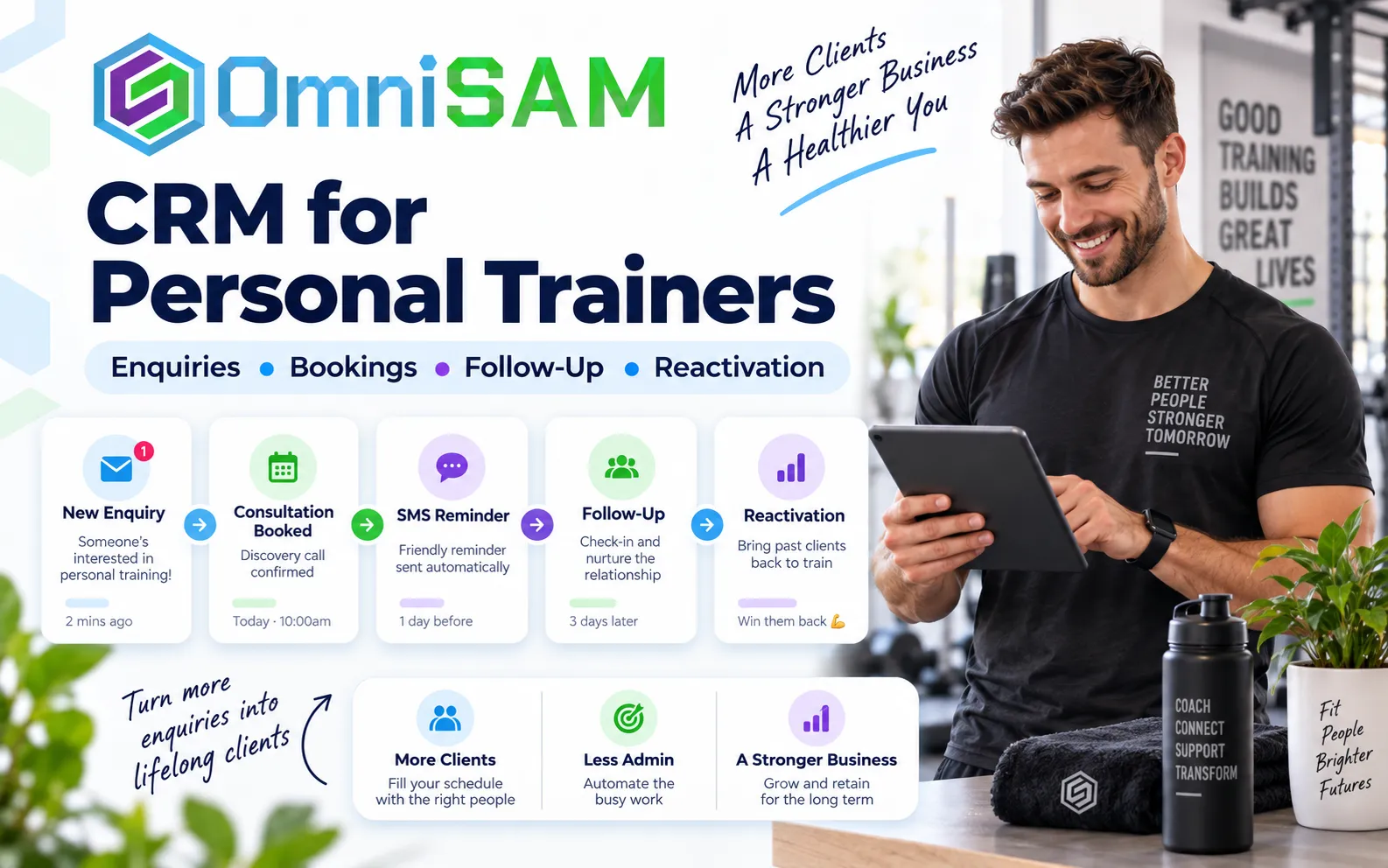
CRM for Personal Trainers in Melbourne
See how CRM, automated follow-up, reminders and client reactivation can help Melbourne personal trainers manage enquiries and the client journey more consistently.
CRM for Melbourne Small Businesses: Stop Losing Leads and Start Growing in 2026
Here is a scenario that probably feels familiar. Someone reaches out about your services. You are in the middle of a job, a meeting, or just a genuinely hectic Tuesday. You make a mental note to follow up later...
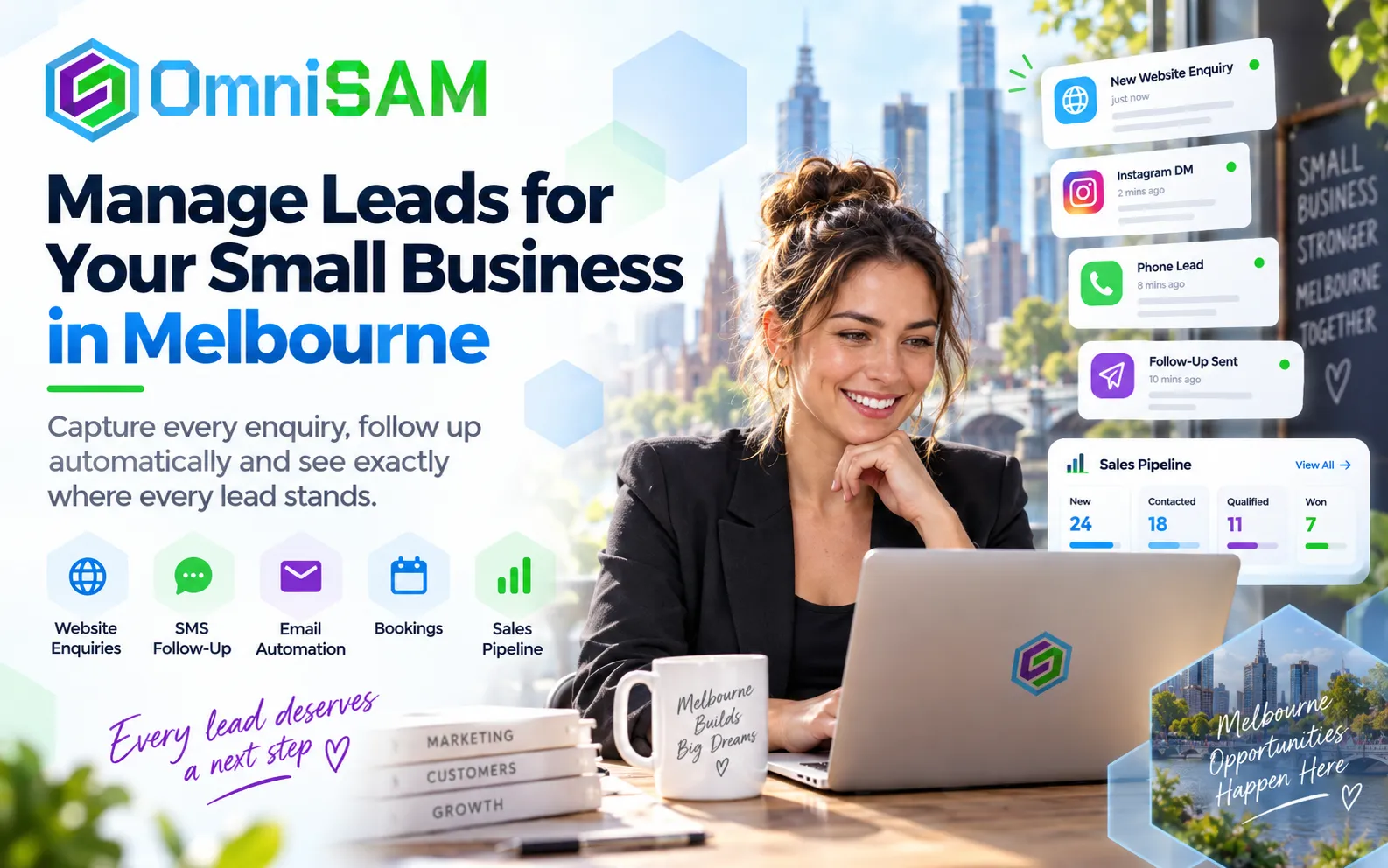
How to Manage Leads for Your Small Business in Melbourne (2026 Guide)
Discover how Melbourne small businesses use OmniSAM to manage leads, build pipelines and convert more clients. Start your free trial today.